McCosker's Flasher Wrasse
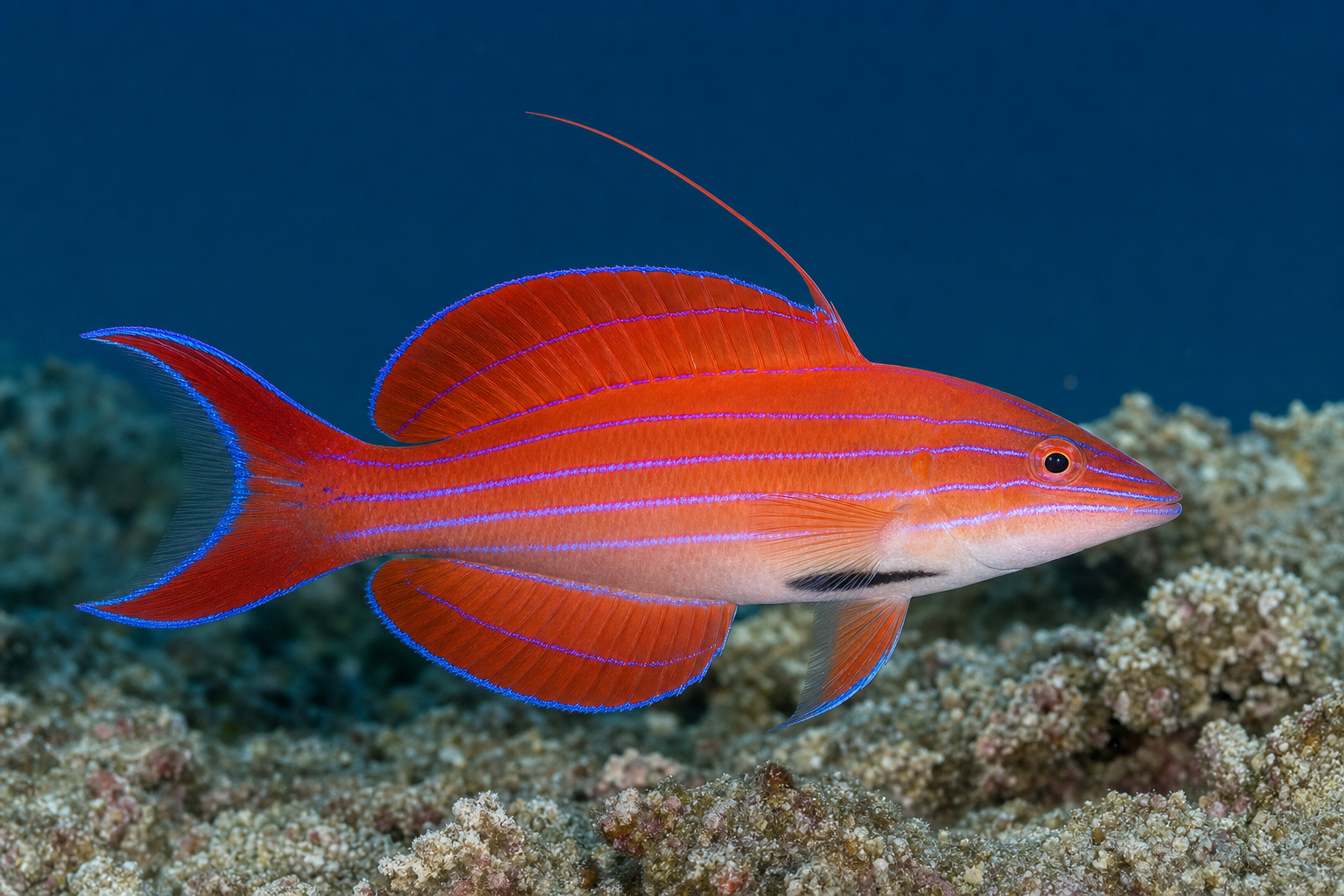
McCosker's flasher wrasse is a small labrid that rarely exceeds 8 cm, described in 1977 by John Randall and Mireille Harmelin-Vivien and named for the American ichthyologist John McCosker, who collected the type specimens. The dominant male is a jewel: orange flanks ruled with fine magenta lines, a paler belly, a dorsal fin drawn out into soft filaments and a notched tail. Females are far plainer, pinkish and without those trailing appendages. The common name comes from the nuptial flash — for a few seconds the male throws open every fin and sets his colours ablaze to court a female or warn off a rival, then drops straight back into ordinary dress. Several Paracheilinus species look much alike and are routinely confused in the trade. The species lives in the Indian Ocean, from East Africa to Thailand and northern Sumatra, at depths of 5 to 40 metres. It favours reef slopes and rubble zones swept by current, where plankton drifts past in quantity. Groups hang in open water just above the substrate, each built around a territorial male patrolling over a harem of females and ready to drop into the rockwork at the first alarm. Spawning happens late in the day, in midwater, the eggs left to the current. Like many wrasses it is a protogynous hermaphrodite: every individual is born female, and the dominant one switches sex within a week or two if the male disappears. In a reef aquarium, allow 200 litres as a minimum — enough for one male with three to five females, the arrangement that shows the species at its best, since a male with no audience almost never flashes. A single fish is perfectly viable too. This tireless swimmer needs open water and flow, but also rock to bolt into. One point is non-negotiable: it is a formidable jumper, and an open tank ends sooner or later with a fish on the floor, so a gap-free cover is mandatory. A zooplankton feeder, it wants small items — mysis, brine shrimp, cyclops, copepods — offered two or three times a day, as its tiny stomach stores nothing. Harmless to corals and invertebrates, it is sensitive to shipping: insist on a specimen already settled and feeding.
About the name : Described by Randall & Harmelin-Vivien in 1977; the name remains valid and the species has not been reclassified. Note a conflict between sources on range: Wikipedia restricts it to the Indian Ocean (East Africa to Thailand and northern Sumatra), while some aquarium databases extend it as far as Fiji. The genus Paracheilinus contains several near-identical species that are frequently confused in the trade, so Pacific specimens sold under this name should be treated with caution.
Water parameters
| Temperature | 22 – 26 °C |
|---|---|
| pH | 8.1 – 8.4 |
| Carbonate hardness (KH) | 8 – 12 °dKH |
| Salinity | 33 – 35 SG |
Tank & stocking
| Minimum tank volume | 200 L |
|---|---|
| Volume budget per individual | 30 L — adds up with tank-mates |
“Minimum tank volume” is a reasonable floor, not an absolute limit. The per-individual budget is used by the Aqua app to estimate how heavily a tank is stocked.
Frequently asked questions
What size aquarium does McCosker's Flasher Wrasse need?
Provide at least 200 litres to keep McCosker's Flasher Wrasse in good conditions.
What water parameters does McCosker's Flasher Wrasse need?
A temperature of 22–26 °C, pH 8.1–8.4, saltwater.
Is McCosker's Flasher Wrasse peaceful or aggressive?
Its temperament is peaceful.
What does McCosker's Flasher Wrasse eat?
Its diet: planktivore.
How big does McCosker's Flasher Wrasse get?
Around 8 cm as an adult.
Is McCosker's Flasher Wrasse suitable for beginners?
Care level: intermediate.
Planning a tank with McCosker's Flasher Wrasse?
AquaTender turns these parameters into live advice: it checks whether your tank is big enough, how heavily it's stocked, and whether your fish are compatible — then tracks water tests, photos and maintenance for you.
Fish from the same biotope
Report an error on this page
Care data is community-assisted. Spotted something wrong? Let us know — it won't change the page instantly, but it goes to moderation.
Care data is generated and manually reviewed; always cross-check before major decisions. ← Back to the encyclopedia