Peacock Eel
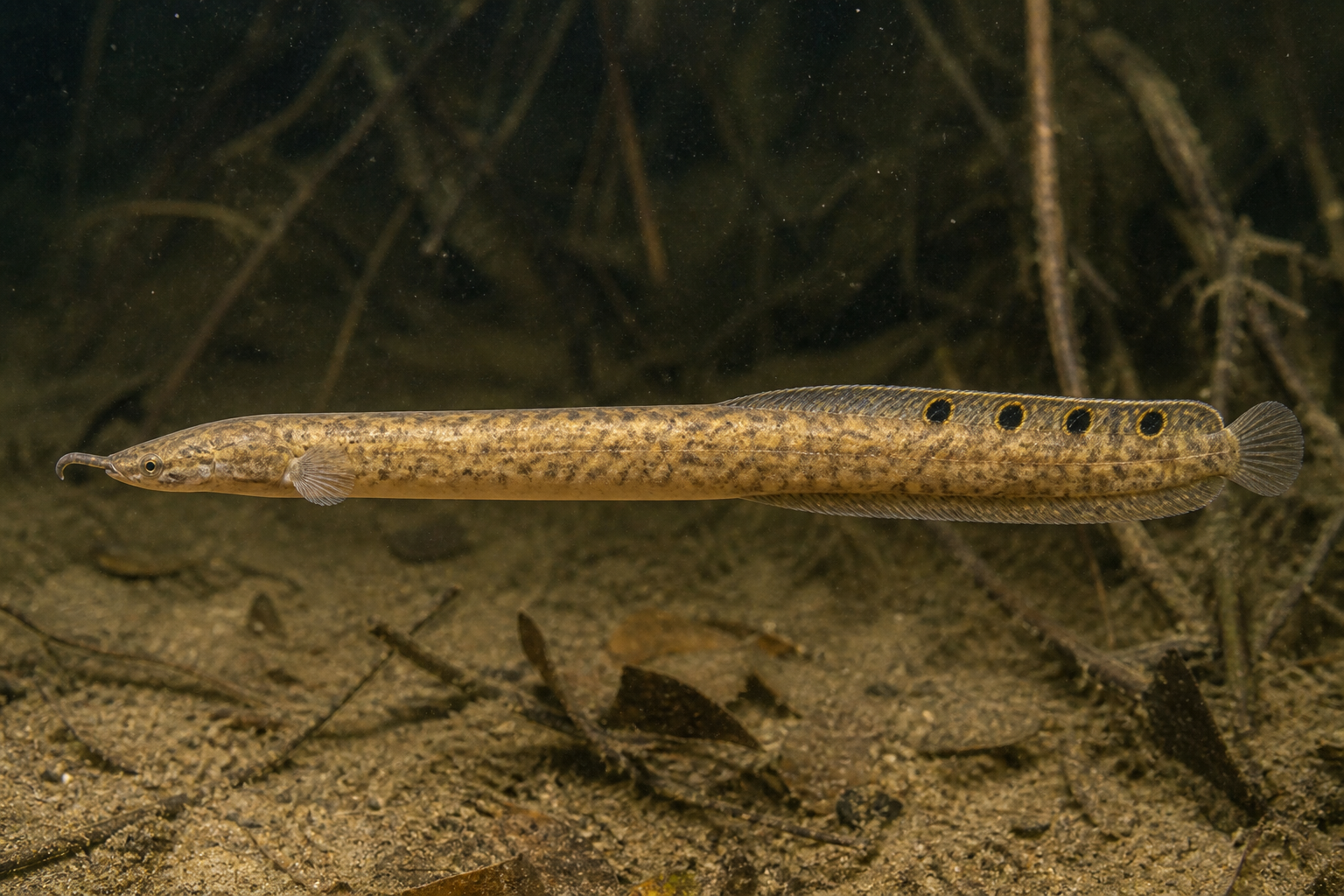
Macrognathus siamensis belongs to the Mastacembelidae, the spiny eels — not true eels at all, but elongated perciform fishes with a fleshy, flexible snout used to probe the substrate. The scaleless body is light brown, crossed by a thin pale stripe running from the eye to the tail base, and the rear of the dorsal fin carries three to six pale-ringed ocelli reminiscent of peacock feathers, which is where the common name comes from. The front of the dorsal fin is reduced to a row of short, erect spines sharp enough to pierce skin, so specimens are best moved in a container rather than a net, in which the rays inevitably snag. Reported maximum length is 30 cm, though most aquarium fish stop around 20 to 25 cm. The species inhabits the Mekong, Chao Phraya and Maeklong basins together with the rivers of peninsular Thailand, favouring slow or standing water: backwaters, swamps, canals and ponds over sand, mud or silt. It spends daylight buried with only the head showing, emerging at dusk to sift the top layer of the bottom for insect larvae, crustaceans and worms, and follows seasonal floods into inundated forest. Released by the aquarium trade, it has established itself in the Florida Everglades. A 180-litre tank, longer than it is tall, suits one adult; floor area matters far more than height, and a fine sand bed of at least 5 cm is essential for a scaleless burrower — gravel abrades the skin and invites infection. Roots, leaf litter and shade settle it in, and a tight-fitting lid is not optional, since spiny eels escape through any gap. Peaceful towards anything it cannot swallow, it will swallow anything that fits, so choose sizeable companions. Feed bloodworm, brine shrimp and earthworm, live or frozen; dry pellets are often refused at first. Breeding is rare in captivity and the sexes cannot reliably be told apart.
About the name : Described by Günther in 1861 as Rhynchobdella aculeata siamensis and long placed in the genus Mastacembelus (Mastacembelus siamensis). The trade name Macrognathus siamensis is retained here. Fish are frequently sold under the name of the related Macrognathus aculeatus, so imported specimens should be identified with care.
Water parameters
| Temperature | 23 – 28 °C |
|---|---|
| pH | 6 – 7.5 |
| General hardness (GH) | 5 – 20 °dGH |
Tank & stocking
| Minimum tank volume | 180 L |
|---|---|
| Volume budget per individual | 60 L — adds up with tank-mates |
“Minimum tank volume” is a reasonable floor, not an absolute limit. The per-individual budget is used by the Aqua app to estimate how heavily a tank is stocked.
Frequently asked questions
What size aquarium does Peacock Eel need?
Provide at least 180 litres to keep Peacock Eel in good conditions.
What water parameters does Peacock Eel need?
A temperature of 23–28 °C, pH 6–7.5.
Is Peacock Eel peaceful or aggressive?
Its temperament is peaceful.
What does Peacock Eel eat?
Its diet: carnivore.
How big does Peacock Eel get?
Around 30 cm as an adult.
Is Peacock Eel suitable for beginners?
Care level: intermediate.
Planning a tank with Peacock Eel?
AquaTender turns these parameters into live advice: it checks whether your tank is big enough, how heavily it's stocked, and whether your fish are compatible — then tracks water tests, photos and maintenance for you.
Fish from the same biotope
Report an error on this page
Care data is community-assisted. Spotted something wrong? Let us know — it won't change the page instantly, but it goes to moderation.
Care data is generated and manually reviewed; always cross-check before major decisions. ← Back to the encyclopedia