Heckel Discus
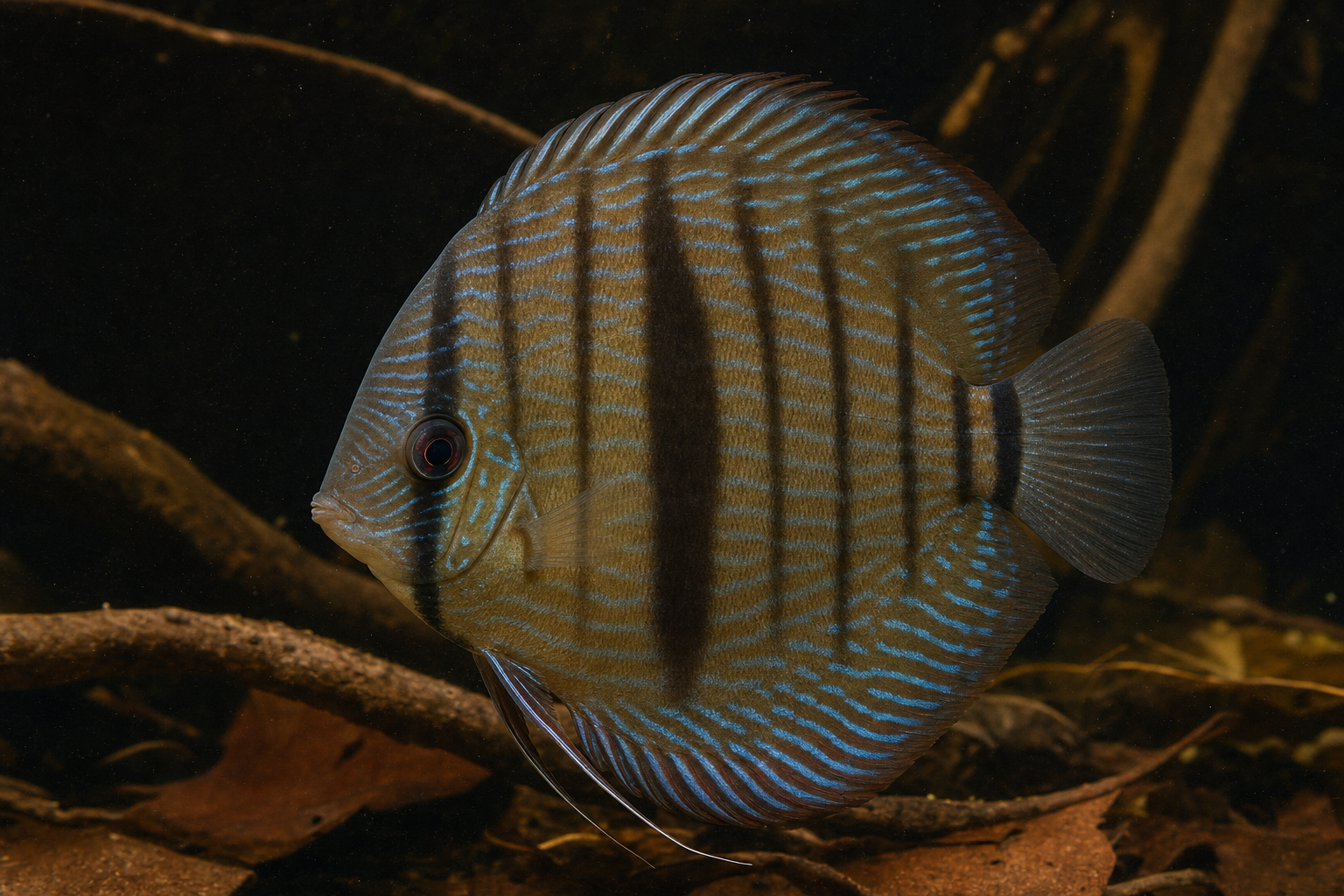
The Heckel discus takes its name from Johann Jakob Heckel, who described it in 1840. A cichlid with a disc-shaped body almost as tall as it is long, it is recognised by the broad dark vertical bar crossing its flank — the famous fifth bar — far more pronounced than in other discus. The reddish-brown body is traced with fine, winding turquoise lines that intensify in conditioned adults. It reaches around twenty centimetres and lives for a decade or so. Unlike Symphysodon aequifasciatus, the source of most colourful farmed strains, the Heckel discus is still largely imported as wild stock. The species is endemic to the Brazilian Amazon, confined to the lower Rio Negro and a handful of neighbouring tributaries — Abacaxis, Trombetas, Nhamundá. It lives exclusively in blackwater: amber, tannin-stained, extremely mineral-poor and acidic, with pH dropping below 5 and hardness close to zero. Temperatures stay high year-round, between 26 and 32 °C. Discus hold to bank margins cluttered with submerged roots and fallen branches, moving vertically between obstacles rather than out in open water. This is not a beginner's fish. It needs a group of at least five in a tank of 300 litres minimum, at least 45 cm tall to suit its build, filled with very soft, acidic water held around 28-30 °C with faultless stability. Classic companions are Amazonian tetras and corydoras, in a layout of vertical roots and broad-leaved plants. It takes frozen foods, meaty granules and homemade pastes, offered in small frequent portions. Breeding happens in pairs on a vertical surface, and the fry feed on mucus secreted by their parents during their first days. The main pitfall is hard tap water, which blocks hatching and wears the adults down.
About the name : Trade name and valid binomial coincide: Symphysodon discus Heckel, 1840. The subspecies Symphysodon discus willischwartzi (Burgess, 1981) is now treated as a synonym. Do not confuse it with Symphysodon aequifasciatus, a distinct species behind most farmed discus sold in shops: the water parameters given here apply to the wild Heckel.
Water parameters
| Temperature | 27 – 31 °C |
|---|---|
| pH | 4.5 – 6 |
| General hardness (GH) | 1 – 3 °dGH |
Tank & stocking
| Minimum tank volume | 300 L |
|---|---|
| Minimum water height | 45 cm — tall-bodied: its fins need height, whatever the volume |
| Volume budget per individual | 50 L — adds up with tank-mates |
| Minimum group size | 5 individuals (shoaling) |
“Minimum tank volume” is a reasonable floor, not an absolute limit. The per-individual budget is used by the Aqua app to estimate how heavily a tank is stocked.
Frequently asked questions
What size aquarium does Heckel Discus need?
Provide at least 300 litres for a small group to keep Heckel Discus in good conditions.
What water parameters does Heckel Discus need?
A temperature of 27–31 °C, pH 4.5–6.
Is Heckel Discus peaceful or aggressive?
Its temperament is peaceful.
What does Heckel Discus eat?
Its diet: omnivore.
How many Heckel Discus should be kept together?
It is a social species: keep a group of at least 5.
How big does Heckel Discus get?
Around 20 cm as an adult.
Is Heckel Discus suitable for beginners?
Care level: advanced.
Planning a tank with Heckel Discus?
AquaTender turns these parameters into live advice: it checks whether your tank is big enough, how heavily it's stocked, and whether your fish are compatible — then tracks water tests, photos and maintenance for you.
Fish from the same biotope
Report an error on this page
Care data is community-assisted. Spotted something wrong? Let us know — it won't change the page instantly, but it goes to moderation.
Care data is generated and manually reviewed; always cross-check before major decisions. ← Back to the encyclopedia