Black leopard wrasse
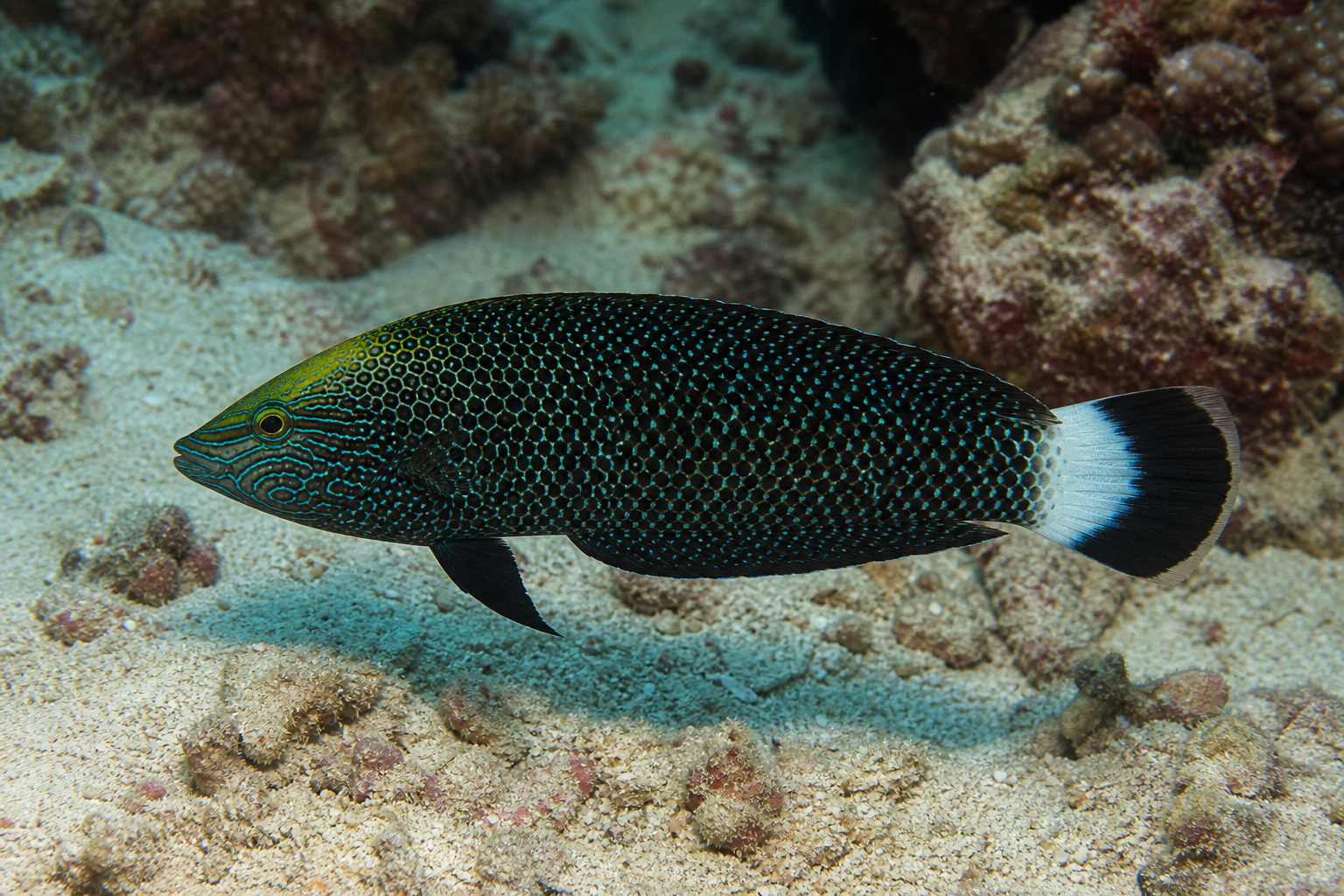
The black leopard wrasse (Macropharyngodon negrosensis) is a small marine wrasse of the family Labridae, native to reefs of the western Pacific and eastern Indian Ocean. It has an ornate pattern of dark spots and reticulations over a lighter body, with coloration differing between males and females. Like other leopard wrasses, it buries itself in sand at night and when stressed. It is a peaceful, somewhat shy species that mixes well in a calm community and does best when other fish are not overly boisterous. Multiple individuals can sometimes be kept together in larger systems. A mature reef aquarium with a deep sand bed and abundant live rock is important, as it grazes on tiny crustaceans and other microfauna. This diet requirement makes it a delicate species that needs an established tank and frequent small feedings of enriched frozen foods. It is considered reef-safe. Captive breeding is not established.
Water parameters
| Temperature | 23 – 27 °C |
|---|---|
| pH | 8.1 – 8.4 |
| Carbonate hardness (KH) | 7 – 12 °dKH |
| Salinity | 33 – 35 SG |
Tank & stocking
| Minimum tank volume | 200 L |
|---|---|
| Volume budget per individual | 50 L — adds up with tank-mates |
“Minimum tank volume” is a reasonable floor, not an absolute limit. The per-individual budget is used by the Aqua app to estimate how heavily a tank is stocked.
Frequently asked questions
What size aquarium does Black leopard wrasse need?
Provide at least 200 litres to keep Black leopard wrasse in good conditions.
What water parameters does Black leopard wrasse need?
A temperature of 23–27 °C, pH 8.1–8.4, saltwater.
Is Black leopard wrasse peaceful or aggressive?
Its temperament is peaceful.
What does Black leopard wrasse eat?
Its diet: carnivore.
How big does Black leopard wrasse get?
Around 12 cm as an adult.
Is Black leopard wrasse suitable for beginners?
Care level: advanced.
Planning a tank with Black leopard wrasse?
AquaTender turns these parameters into live advice: it checks whether your tank is big enough, how heavily it's stocked, and whether your fish are compatible — then tracks water tests, photos and maintenance for you.
Fish from the same biotope
Report an error on this page
Care data is community-assisted. Spotted something wrong? Let us know — it won't change the page instantly, but it goes to moderation.
Care data is generated and manually reviewed; always cross-check before major decisions. ← Back to the encyclopedia