Radiant wrasse
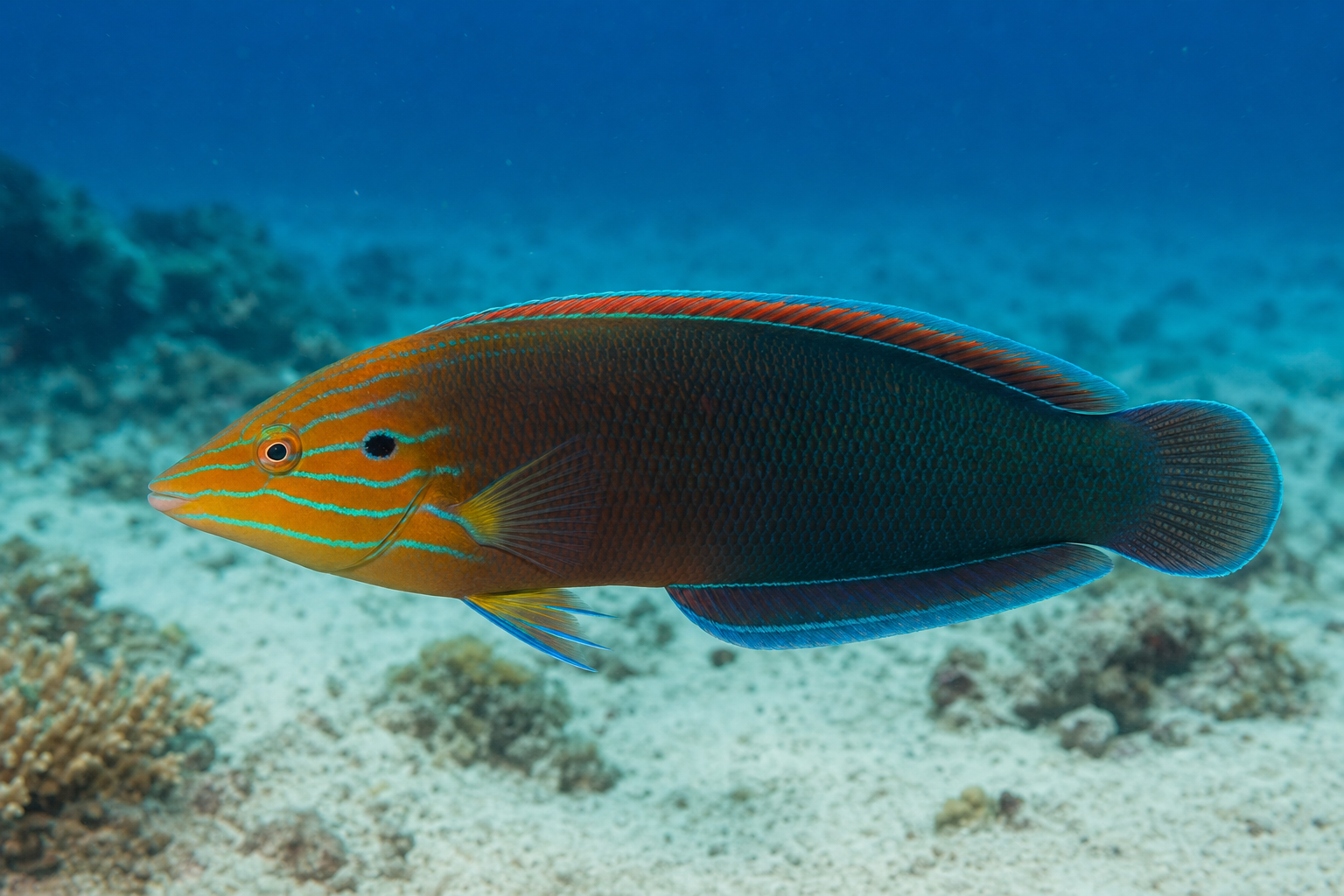
The radiant wrasse is a small marine fish of the family Labridae, native to reefs of the eastern Indian Ocean and western Pacific. It has a warm orange to reddish body with lighter markings, a dark spot on the head or nape, and blue and green highlights, showing brighter coloration in terminal-phase males. It is a peaceful, active wrasse that buries itself in the sand at night and when alarmed, and can be kept singly or in small groups. It requires a fine sand bed for burrowing, ample live rock, and a secure lid since wrasses are prone to jumping. It is a carnivore feeding on small invertebrates such as copepods, amphipods and small worms, and it helps control pest fauna; it should also be offered frozen and prepared meaty foods. Reef-safe and hardy once established, it is a good active swimmer for reef aquariums and mixes well with other peaceful fish.
Water parameters
| Temperature | 23 – 27 °C |
|---|---|
| pH | 8.1 – 8.4 |
| Carbonate hardness (KH) | 8 – 12 °dKH |
| Salinity | 33 – 35 SG |
Tank & stocking
| Minimum tank volume | 150 L |
|---|---|
| Volume budget per individual | 40 L — adds up with tank-mates |
“Minimum tank volume” is a reasonable floor, not an absolute limit. The per-individual budget is used by the Aqua app to estimate how heavily a tank is stocked.
Frequently asked questions
What size aquarium does Radiant wrasse need?
Provide at least 150 litres to keep Radiant wrasse in good conditions.
What water parameters does Radiant wrasse need?
A temperature of 23–27 °C, pH 8.1–8.4, saltwater.
Is Radiant wrasse peaceful or aggressive?
Its temperament is peaceful.
What does Radiant wrasse eat?
Its diet: carnivore.
How big does Radiant wrasse get?
Around 9 cm as an adult.
Is Radiant wrasse suitable for beginners?
Care level: intermediate.
Planning a tank with Radiant wrasse?
AquaTender turns these parameters into live advice: it checks whether your tank is big enough, how heavily it's stocked, and whether your fish are compatible — then tracks water tests, photos and maintenance for you.
Fish from the same biotope
Report an error on this page
Care data is community-assisted. Spotted something wrong? Let us know — it won't change the page instantly, but it goes to moderation.
Care data is generated and manually reviewed; always cross-check before major decisions. ← Back to the encyclopedia