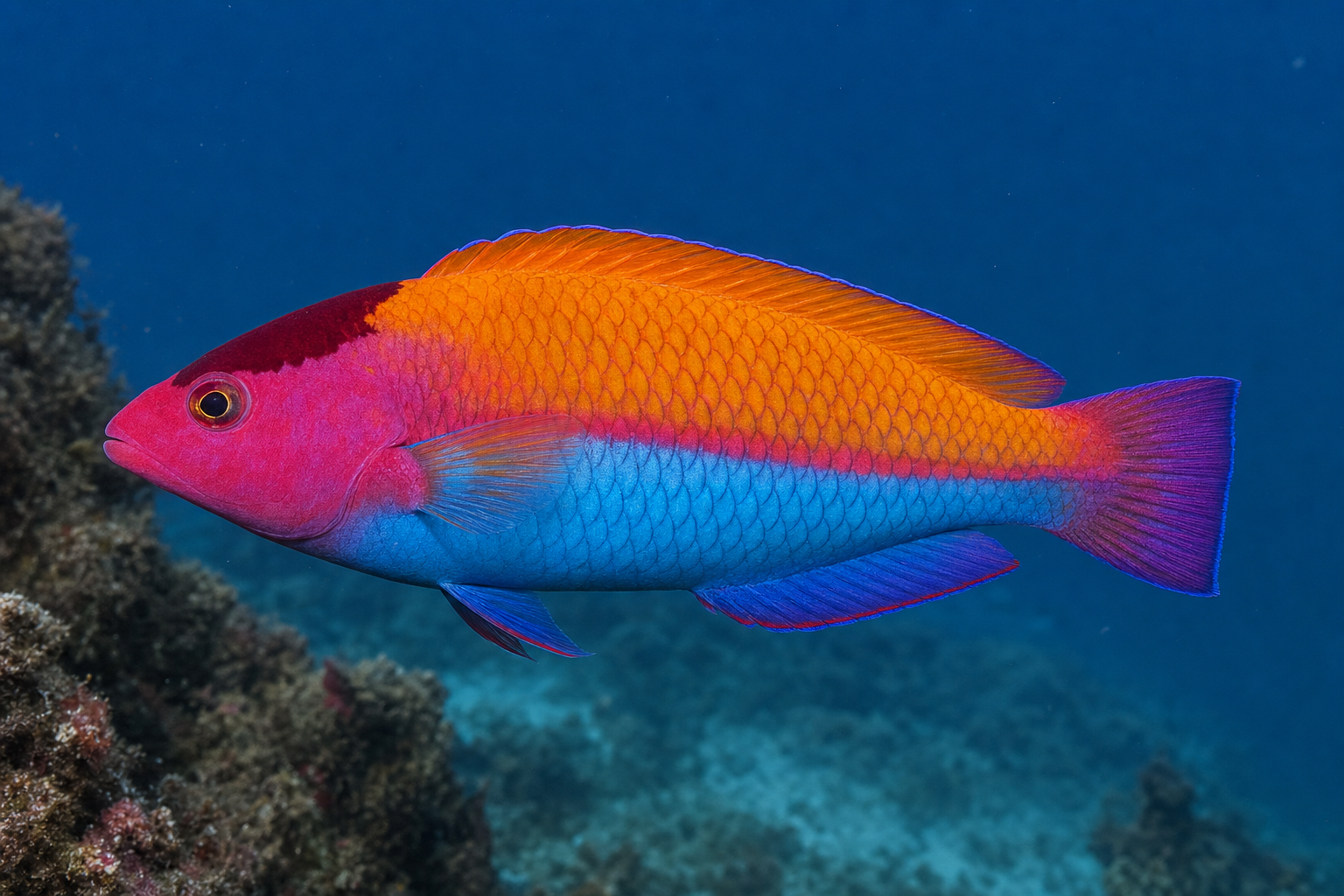
Orange-back fairy wrasse
The orange-back fairy wrasse is a marine wrasse (family Labridae) from Indonesian waters, particularly the Tomini Bay region of Sulawesi. Males show a vivid orange to red back over a pinkish body with blue and purple accents, colors that flare during display, while females are less intensely marked. It is an active, peaceful wrasse best kept singly or as one male with several females. Males display energetically but are not aggressive toward unrelated tankmates. It thrives in a reef aquarium with abundant live rock, open swimming space, and a tightly fitting lid, since fairy wrasses jump readily. Fully reef-safe, it feeds on zooplankton and small crustaceans and should be given frequent feedings of mysis, enriched brine shrimp, and fine prepared foods.
Water parameters
| Temperature | 24 – 27 °C |
|---|---|
| pH | 8.1 – 8.4 |
| Carbonate hardness (KH) | 8 – 12 °dKH |
| Salinity | 33 – 35 SG |
Tank & stocking
| Minimum tank volume | 250 L |
|---|---|
| Volume budget per individual | 50 L — adds up with tank-mates |
“Minimum tank volume” is a reasonable floor, not an absolute limit. The per-individual budget is used by the Aqua app to estimate how heavily a tank is stocked.
Frequently asked questions
What size aquarium does Orange-back fairy wrasse need?
Provide at least 250 litres to keep Orange-back fairy wrasse in good conditions.
What water parameters does Orange-back fairy wrasse need?
A temperature of 24–27 °C, pH 8.1–8.4, saltwater.
Is Orange-back fairy wrasse peaceful or aggressive?
Its temperament is peaceful.
What does Orange-back fairy wrasse eat?
Its diet: carnivore.
How big does Orange-back fairy wrasse get?
Around 9 cm as an adult.
Is Orange-back fairy wrasse suitable for beginners?
Care level: intermediate.
Planning a tank with Orange-back fairy wrasse?
AquaTender turns these parameters into live advice: it checks whether your tank is big enough, how heavily it's stocked, and whether your fish are compatible — then tracks water tests, photos and maintenance for you.
Fish from the same biotope
Report an error on this page
Care data is community-assisted. Spotted something wrong? Let us know — it won't change the page instantly, but it goes to moderation.
Care data is generated and manually reviewed; always cross-check before major decisions. ← Back to the encyclopedia