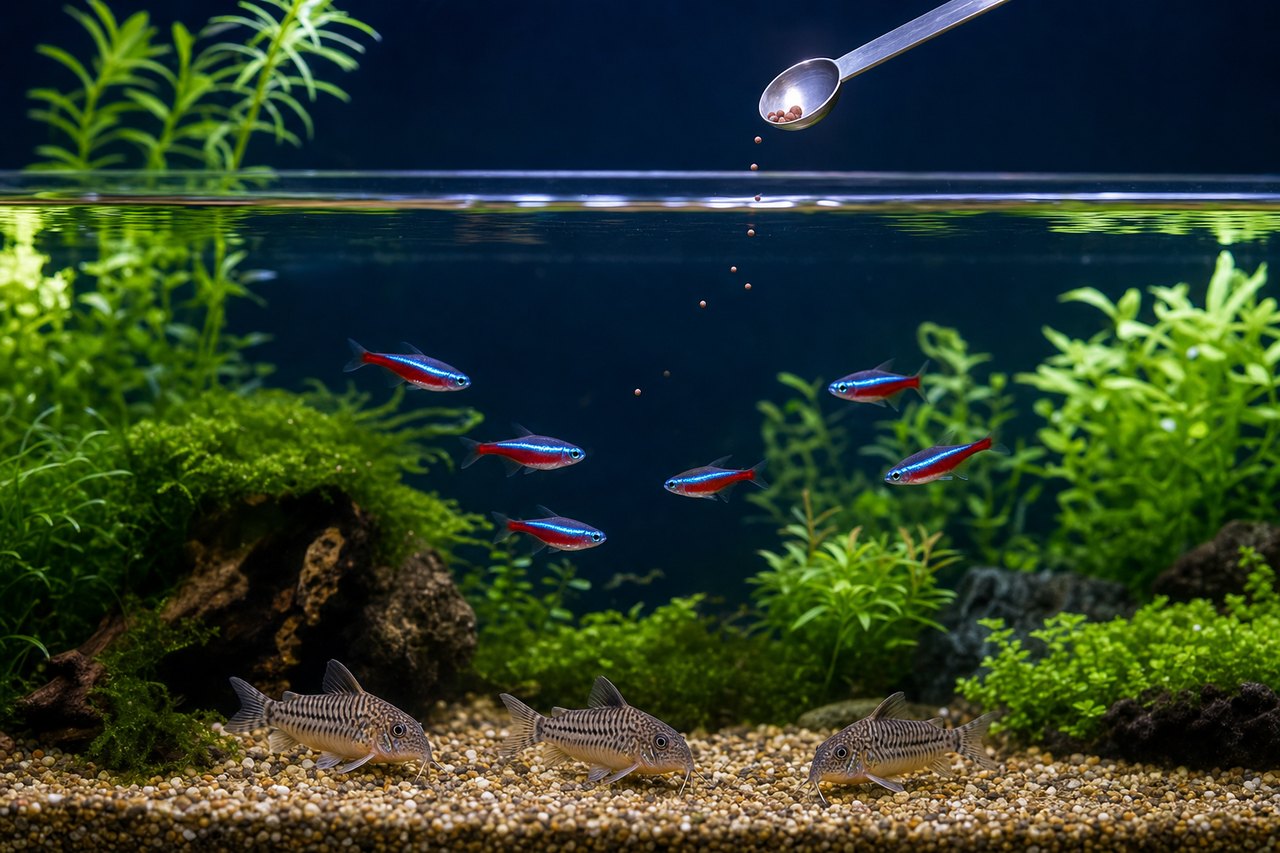
How to Feed Aquarium Fish Properly: A Beginner's Guide
Learn how much, how often, and what to feed your aquarium fish, and why overfeeding is the mistake almost every beginner makes.
Why Feeding Well Matters More Than You Think
Feeding looks like the simplest part of fishkeeping, yet it is where most beginners go wrong. The problem is rarely underfeeding; it is almost always overfeeding. Uneaten food sinks, rots, and feeds a spike in ammonia and nitrite, the two compounds most likely to harm or kill your fish. Getting feeding right protects both your fish and your water quality at the same time.

A healthy fish is active, has a rounded but not swollen belly, and shows bright colours. A well-fed tank has clean gravel, clear water, and stable test readings. Everything below is aimed at that outcome.
How Often Should You Feed?
For most community fish, feeding once or twice a day is plenty. Small, frequent meals suit the way fish digest, but two modest feedings are perfectly adequate and easier to control. Adult fish can comfortably handle one feeding a day.
The golden rule: feed only what your fish can eat in about two minutes. If food is still drifting to the bottom after that, you gave too much. Scoop out any leftovers with a net.
Some feeding notes worth knowing:
- Fry (baby fish) are the exception; they need small meals three to five times a day.
- Nocturnal fish such as many catfish feed best after lights-out, when they naturally forage.
- A weekly fasting day is beneficial for many species. It lets the digestive system clear and reduces waste. Fish do not starve after 24 hours without food.
How Much Is the Right Amount?
A useful mental image: a fish's stomach is roughly the size of its eye. That is a tiny volume. Beginners routinely pour in far more than that.
Start deliberately small. Add a pinch, watch the fish eat, and only add a little more if it all disappears quickly and the fish still hunt. It is always safer to underfeed slightly than to overfeed. Underfed fish get thin over weeks; overfed tanks crash in days.
What to Feed: Building a Varied Diet
No single food covers everything a fish needs. A varied diet keeps fish healthier and more colourful. Match the food to where your fish feed in the water column and to whether they are herbivores, carnivores, or omnivores.
Everyday staples
- Flakes: good for surface and mid-water feeders like tetras and guppies.
- Pellets and granules: come in floating and sinking forms; choose sinking types for bottom dwellers such as corydoras and loaches.
- Algae wafers: essential for plecos and other grazers.
Treats and supplements
- Frozen or live foods such as bloodworms, brine shrimp, and daphnia add protein and encourage natural behaviour. Offer them once or twice a week, not daily.
- Blanched vegetables like courgette, cucumber, or spinach suit many herbivores.
Buy food in small quantities and replace it every three to six months. Vitamins in fish food degrade over time, so a giant tub that lasts two years is a false economy.
Reading Your Fish and Your Water
Your fish and your test kit tell you whether feeding is on track. In a properly cycled aquarium your target readings are ammonia 0 mg/L and nitrite 0 mg/L, with nitrate kept below about 40 mg/L. If ammonia or nitrite ever climb above zero, overfeeding is one of the first culprits to suspect. Cut back food, remove waste, and test again.
Remember that a new aquarium must be cycled before it is stocked. Building the beneficial bacteria that process fish waste takes roughly three to six weeks. During and after cycling, a 20 to 30% water change every week keeps nitrate and dissolved waste under control, working hand in hand with sensible feeding.
Common Feeding Mistakes to Avoid
- Feeding because the fish "beg." Fish learn to swim to the front whenever you approach. It is behaviour, not genuine hunger.
- Topping up after every glance at the tank. Stick to your one or two daily feedings.
- Ignoring the bottom. Food trapped in gravel or behind decor rots out of sight. Vacuum the substrate during water changes.
- One food forever. A single flake brand day after day leads to dull colours and poor health.
- Feeding before a holiday. Do not overload the tank before you leave. Most fish handle several days without food better than a fouled tank; use a reliable automatic feeder or an established slow-release block for longer trips.
Feeding When You Are Away
For a weekend of two or three days, healthy adult fish are fine with no food at all; this is far safer than asking a non-fishkeeper to feed them, since guests almost always overfeed. For longer absences, an automatic feeder dispensing pre-measured portions is the most reliable option. Test it for a few days before you rely on it.
Build a Simple Routine
Consistency beats guesswork. Feed at roughly the same times, keep portions small, vary the menu across the week, and pair feeding with weekly testing and water changes. Once this becomes habit, feeding takes a minute a day and your tank stays stable.
If you would like help keeping track of feeding times, fasting days, water changes, and test results in one place, the AquaTender app can send gentle reminders and log your routine so nothing slips through the cracks.
Feed a little, feed varied, and watch your fish rather than the clock. Do that, and both your fish and your water will thank you.