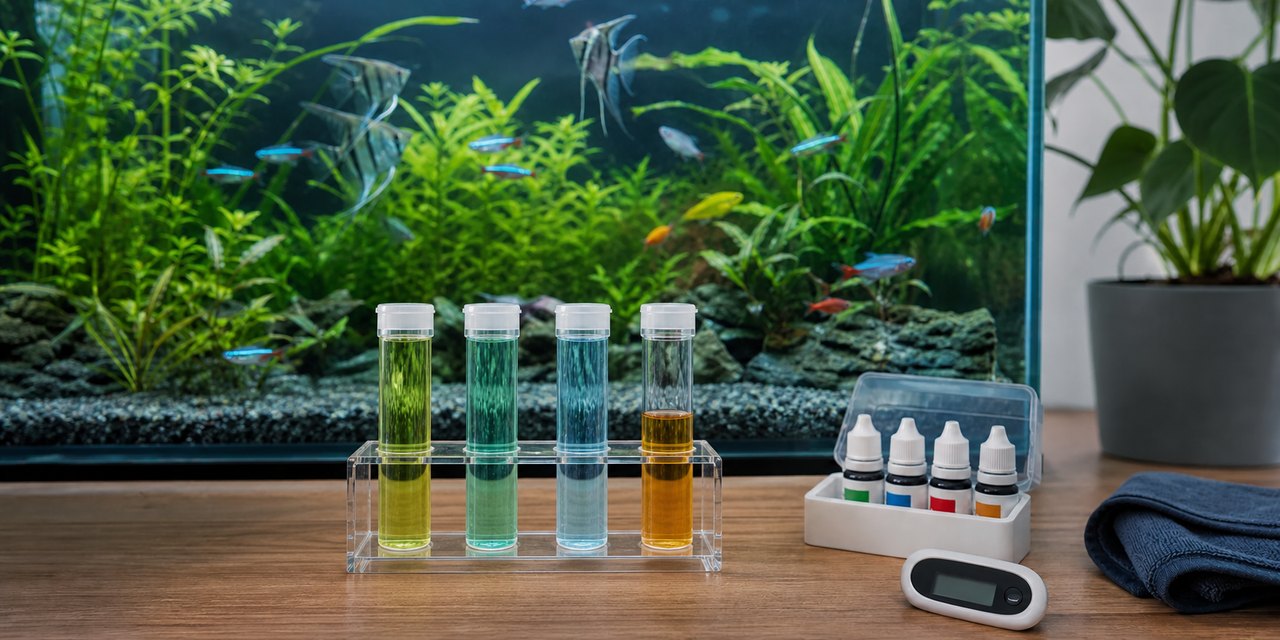
Understanding Water Parameters: pH, GH, KH and Temperature
A beginner-friendly guide to pH, GH, KH and temperature: what each value means, healthy ranges, and how to keep your aquarium water stable.
Why water parameters matter
Your fish live inside their water the way you live inside air. Everything they breathe, drink and absorb comes from that water, so its chemistry directly shapes their health. The good news is that you only need to understand a handful of numbers to keep a stable, thriving tank. The four that matter most for beginners are pH, GH, KH and temperature.
A key idea runs through all of them: fish tolerate a stable value far better than a "perfect" one that swings around. A tank sitting steadily at pH 7.6 is healthier than one bouncing between 6.8 and 7.8. Aim for stability first, ideal numbers second.
pH: how acidic or alkaline the water is
pH measures acidity on a scale from 0 to 14. Below 7 is acidic, 7 is neutral, and above 7 is alkaline (basic). Most common community fish are comfortable between 6.5 and 7.8. Some species have preferences: soft-water fish like neon tetras or dwarf cichlids lean acidic, while livebearers such as guppies and mollies prefer harder, alkaline water around 7.5 to 8.0.
The scale is logarithmic, meaning each whole number is a tenfold change. A drop from pH 7 to pH 6 is ten times more acidic, so sudden shifts are stressful. Test your tap water and your tank water; if they differ a lot, add new water slowly during changes. Resist the urge to chase a textbook number with chemical "pH down" products, which often cause the very swings you are trying to avoid.
GH: general hardness, the mineral content
GH (general hardness) measures dissolved minerals, mainly calcium and magnesium. It is usually reported in degrees (dGH) or parts per million (ppm), where 1 dGH is about 17.9 ppm. Think of GH as how "mineral-rich" the water is.
- Soft water: 0 to 6 dGH, suited to tetras, rasboras and many Amazonian species.
- Moderate: 6 to 12 dGH, a comfortable middle for most community fish.
- Hard water: 12 to 20+ dGH, ideal for livebearers, African cichlids and most snails and shrimp, which need minerals to build shells and molt.
GH matters more than many beginners realize, because minerals support fish physiology and plant growth. If your tap water is very soft, remineralizing products or a small amount of crushed coral can raise GH gently.
KH: carbonate hardness, your pH shock absorber
KH (carbonate hardness, sometimes called alkalinity) measures carbonates and bicarbonates. Its real job is to buffer pH, resisting sudden changes. A tank with healthy KH holds its pH steady; a tank with near-zero KH can crash from pH 7 to pH 5 overnight, a dangerous event.
For most freshwater tanks, aim for a KH of roughly 4 to 8 dKH (about 70 to 140 ppm). If your KH is very low and your pH keeps drifting downward, add a little crushed coral, aragonite or a commercial buffer to stabilize it. KH and pH are linked: raising KH usually nudges pH up and keeps it there. Watch KH especially in planted or heavily stocked tanks, where acids build up between water changes.
Temperature: the invisible parameter
Temperature drives your fish's metabolism, immune system and oxygen levels. Most tropical community fish thrive between 24 and 27 °C (75 to 80 °F). Coldwater species like goldfish prefer 18 to 22 °C, while bettas like it a touch warmer, around 26 to 28 °C.
Use a reliable heater with a thermostat and a separate thermometer to verify it, since heaters can fail or stick. Warmer water holds less dissolved oxygen, so in summer make sure the surface is agitated for gas exchange. Avoid rapid temperature swings; when adding new fish, float and acclimate them so the change is gradual rather than a shock.
The nitrogen cycle: the parameter behind the parameters
Before any fish move in, a new tank must be cycled. Fish waste releases ammonia, which is toxic. Beneficial bacteria convert ammonia to nitrite (also toxic), then nitrite to nitrate (far less harmful). Growing that bacterial colony takes 3 to 6 weeks. Your targets once established are ammonia at 0 mg/L, nitrite at 0 mg/L, and nitrate kept low, ideally under 20 to 40 mg/L. Never add a full stock of fish to an uncycled tank.
Testing and maintaining stable water
You cannot manage what you do not measure. A liquid test kit is more accurate than paper strips and covers pH, ammonia, nitrite, nitrate, GH and KH. For a new tank, test every few days; for an established one, once a week is usually enough, plus a check whenever something looks off.
The single most powerful habit is the regular partial water change: swapping 20 to 30% of the water weekly dilutes nitrate, replenishes minerals and steadies KH. Always match the new water's temperature and treat tap water with a dechlorinator, since chlorine and chloramine harm both fish and your beneficial bacteria.
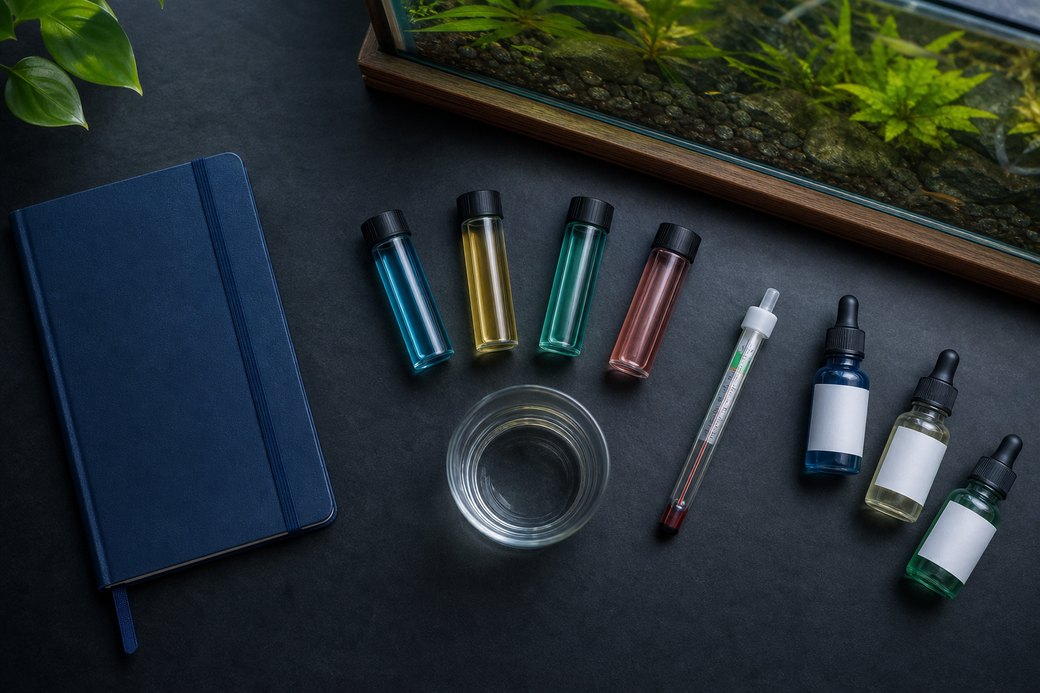
- Test regularly and write the results down so you can spot trends.
- Change 20 to 30% of the water each week with dechlorinated, temperature-matched water.
- Adjust slowly. Small, steady corrections beat dramatic ones.
- Match parameters to your species rather than forcing your species to fit arbitrary numbers.
Keeping on top of all this is easier with a simple routine. An app like AquaTender lets you log your pH, GH, KH and temperature over time and reminds you when a water change is due, so patterns become obvious before they become problems.
Putting it together
You do not need a chemistry degree to keep beautiful, healthy water. Learn what pH, GH, KH and temperature represent, find the ranges your chosen fish enjoy, and then focus on holding those values steady with weekly water changes and regular testing. Stability, patience and observation will do more for your aquarium than any bottle of quick-fix chemicals.